Transmission remanufacturing requires more than cleaning visible exterior surfaces. Transmission housings and components contain internal passages, blind holes, cavities and complex geometries where transmission fluid, oil, grease, road soil and debris can accumulate.
For this application, Alliance engineered a transmission cleaning machine to provide consistent automated cleaning of transmission components while supporting the customer’s high-volume remanufacturing operation.
Customer Background
The customer is a leading transmission remanufacturer supplying rebuilt transmissions for automotive applications. Maintaining consistent cleaning is an important part of preparing used transmission components for inspection, rebuilding and reassembly.
The customer needed transmission cleaning equipment capable of removing accumulated contamination from complex components while keeping pace with production requirements.
Challenge
Cleaning Complex Transmission Components
Used transmission components can contain significant amounts of transmission fluid, oil, grease, road soil and other debris. Transmission housings also present a particular cleaning challenge because contaminants can collect within internal passages, blind holes, cavities and irregular surfaces.
Manual cleaning was labor-intensive and made it more difficult to maintain consistent results at the required production volume.
The customer needed a transmission parts washer capable of:
- Removing heavy oil and grease contamination
- Reaching complex surfaces and internal features
- Processing multiple components consistently
- Managing oils and debris in the wash solution
- Providing rust inhibition
- Removing excess moisture after cleaning
- Supporting continuous production
Solution: Conveyorized Transmission Parts Washer
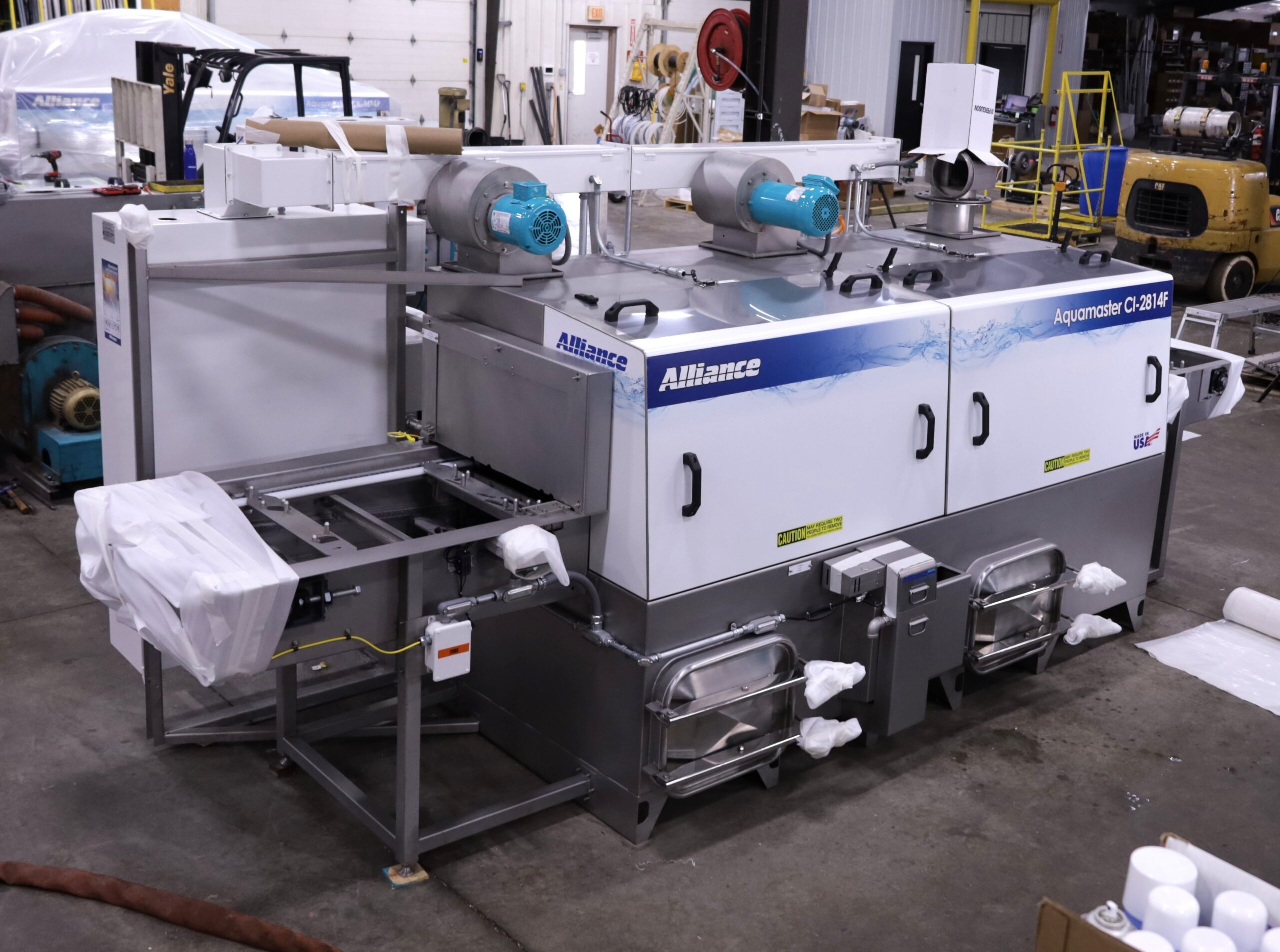
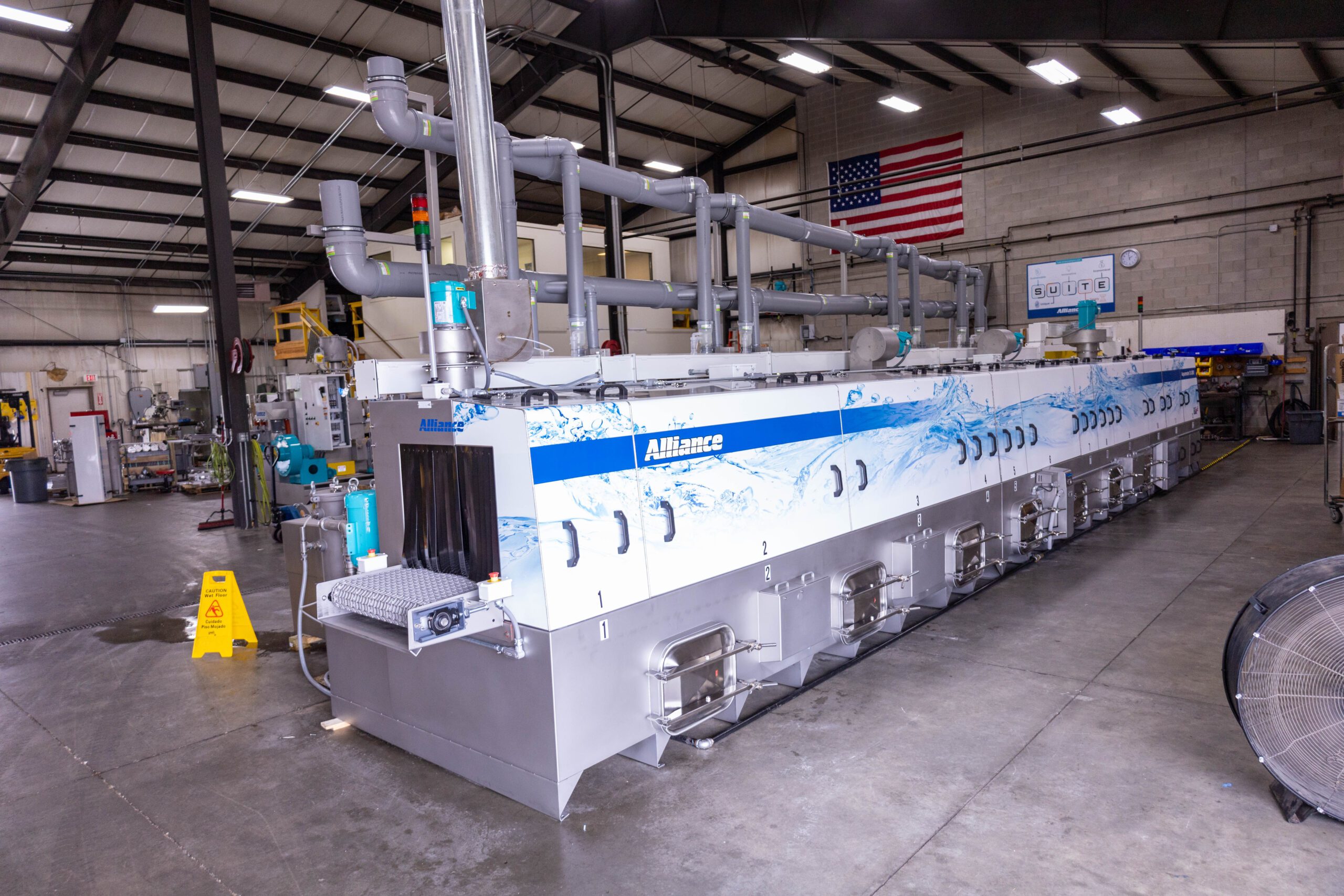
Alliance provided an Aquamaster CB-2820F conveyor belt transmission cleaning machine engineered for large, complex transmission components.
The continuous conveyor design allows carriers of transmission parts to move through multiple cleaning stages at a controlled rate. This provides a repeatable process while reducing the manual handling associated with cleaning individual components.
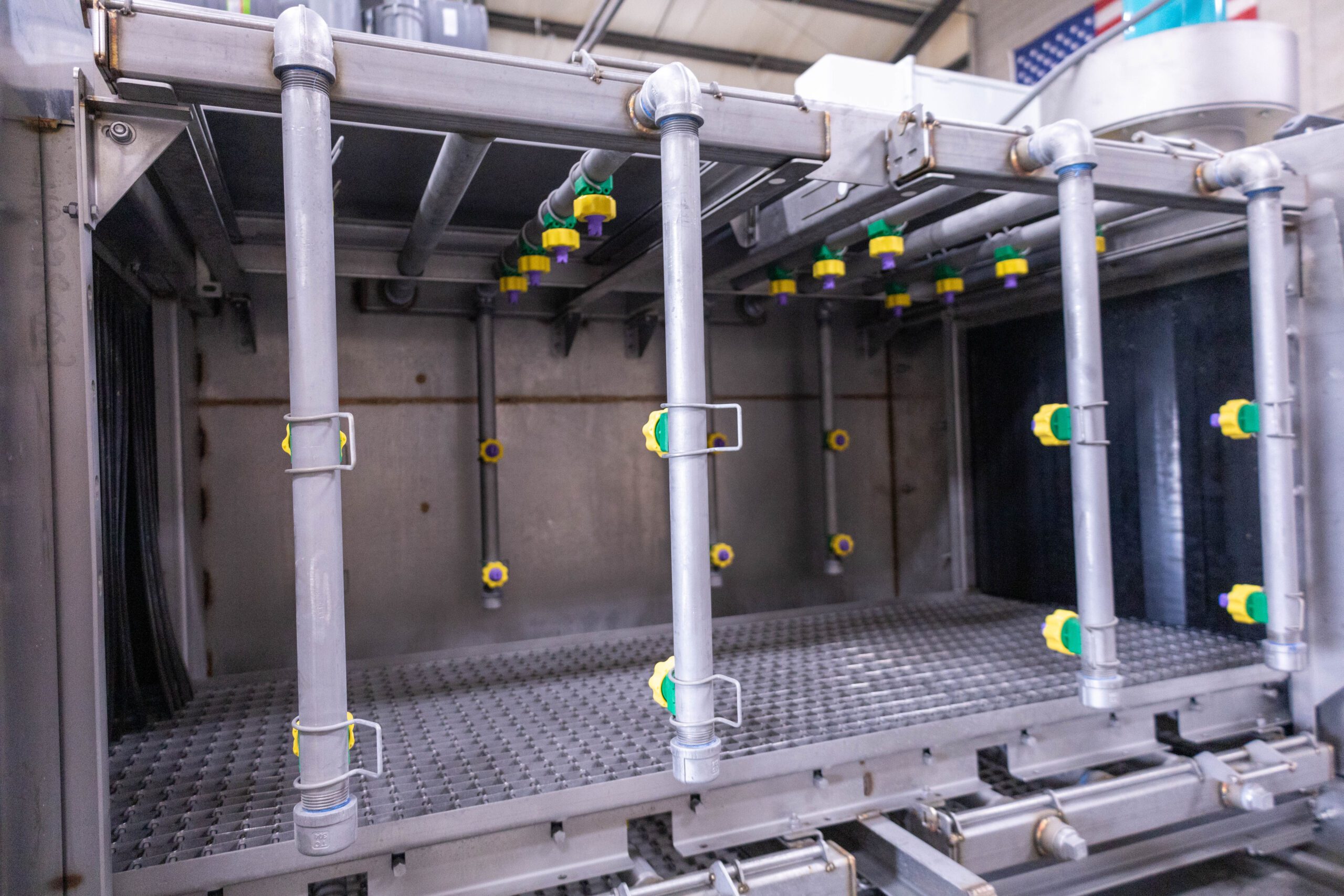
High-pressure spray manifolds and targeted nozzle placement help direct cleaning solution toward difficult-to-reach areas of transmission components, including cavities and complex surfaces.
The system was designed to process approximately 15 to 20 carriers every five minutes, supporting the customer’s production requirements.
Dual Wash and Rust Inhibit Process
The system incorporates a dual-wash process to remove transmission fluid, grease, oils and road contamination.
Using multiple wash stages provides additional cleaning exposure for heavily contaminated components before they proceed to the rust-inhibit stage. The rust-inhibiting process helps protect susceptible metal surfaces as cleaned components move toward inspection and reassembly.
This controlled aqueous process provides a repeatable approach to transmission component cleaning while reducing reliance on manual cleaning methods.
Oil Removal and Filtration
Oil management is particularly important in transmission remanufacturing cleaning because used components can introduce significant amounts of transmission fluid, grease and other soils into the wash solution.
The system incorporates an oil skimmer to remove floating oils along with multi-stage filtration to capture particulate contamination. Managing these contaminants helps maintain wash solution quality and supports consistent cleaning performance.
Effective filtration can also help reduce contaminant recirculation as components continue through the cleaning process.
Heated Blowoff and Drying
After cleaning and rust inhibition, transmission components pass through a heated blowoff stage designed to remove excess moisture.
For this application, some residual moisture was acceptable, so the system did not require components to exit completely dry. Drying requirements can vary depending on the component material, downstream process and customer specifications.
Alliance can configure blowoff and drying systems according to the specific requirements of each application.
Benefits for Transmission Remanufacturing
Automated transmission component cleaning helps create a more controlled process between disassembly and reassembly.
For remanufacturing operations, a properly engineered cleaning system can help:
- Improve cleaning consistency
- Reduce manual cleaning requirements
- Reach difficult component geometries
- Maintain predictable production flow
- Manage oils and particulate contamination
- Prepare components for inspection and reassembly
The appropriate automatic transmission cleaning machine should be selected based on component geometry, contamination level, cleanliness requirements, production rate and required dryness.
Frequently Asked Questions
Need a Transmission Cleaning Solution?
Alliance Manufacturing engineers’ aqueous transmission cleaning equipment around component geometry, contamination, cleanliness requirements, production rate and drying needs.