Purchasing an industrial parts washer is a long-term manufacturing decision. The equipment may operate for years while directly influencing product cleanliness, labor requirements, throughput and downstream quality.
For that reason, comparing equipment based primarily on purchase price can be misleading.
A useful industrial parts washer buying guide should evaluate the entire cleaning process, including the parts, contaminants, production requirements, cleanliness standards, automation and long-term operating requirements.
Here are the most important considerations before investing.
Define What “Clean” Means
Before requesting equipment quotations, establish the required cleaning result.
Some applications require visually clean parts. Others require removal of oil before painting, coating or assembly. Precision manufacturing applications may specify maximum particle sizes, particle counts or other measurable requirements.
Ask:
- What contaminants must be removed?
- Which surfaces must be cleaned?
- Are internal passages involved?
- How will cleanliness be verified?
- What happens to the part after washing?
A well-defined cleanliness specification gives equipment suppliers a measurable target.
Document the Parts and Contamination
An industrial parts cleaning system should be designed around representative production parts.
Provide potential equipment suppliers with information about maximum dimensions, weight, materials, geometry and orientation.
Contamination should be documented just as carefully.
Typical manufacturing soils include:
- Machining oils
- Coolants
- Grease
- Chips
- Fine particulate
- Carbon
- Polishing compounds
- Shop debris
The U.S. EPA notes that aqueous cleaning effectiveness depends on factors including the cleaner formulation, dilution, temperature and cleaning equipment.
Providing accurate application information early in the buying process reduces guesswork.
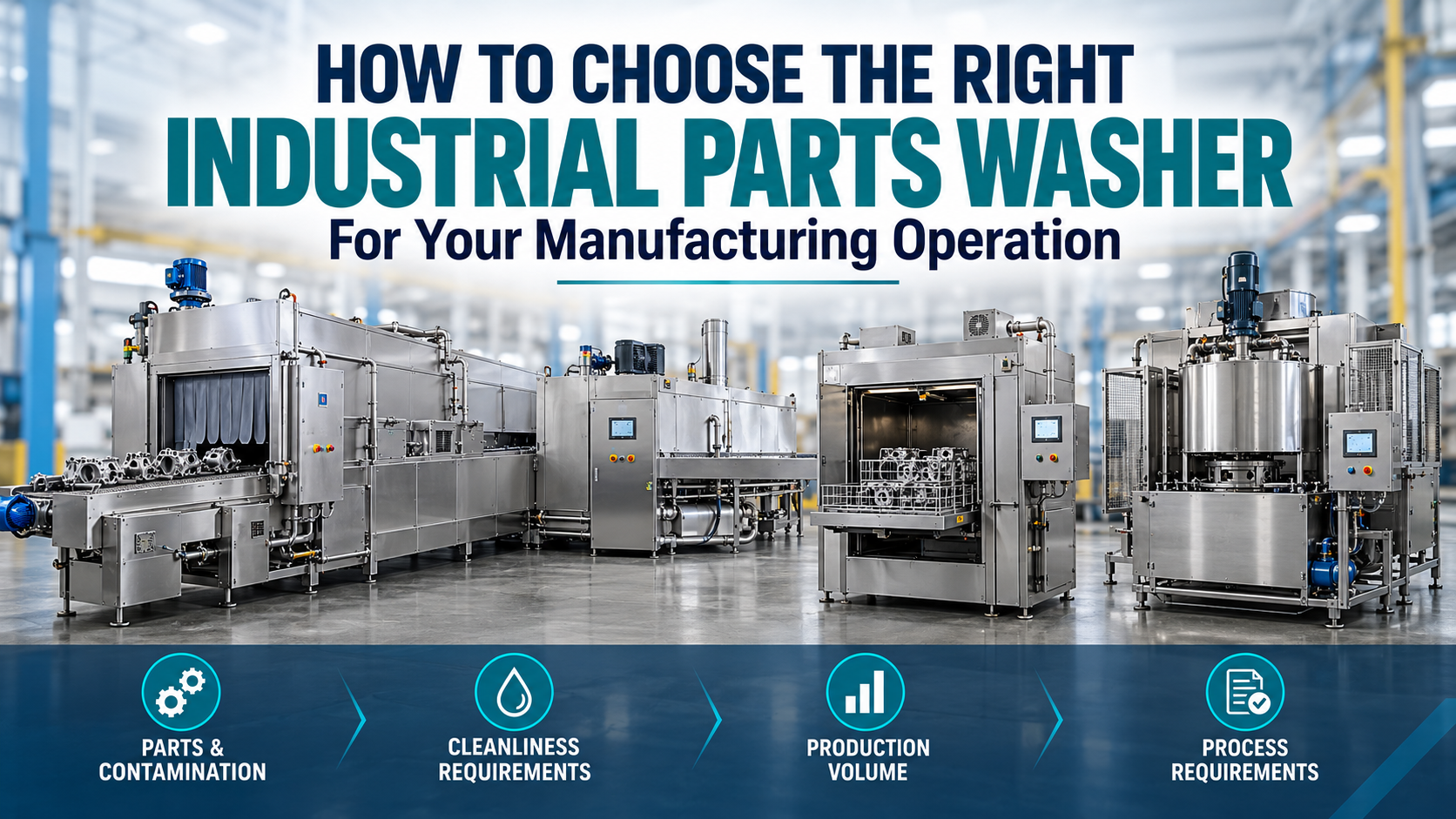
Compare Industrial Parts Washer Types
Different washer configurations serve different production environments.
Cabinet Parts Washers
Cabinet parts washers typically process components in batches and can be appropriate for lower-volume manufacturing, maintenance operations and applications involving larger individual components.
Conveyor Parts Washers
Conveyorized systems move parts continuously through one or more process stages. They are often suited to higher production volumes and can incorporate washing, rinsing, blow-off and drying.
Indexing Parts Washers
Indexing systems move or position components through defined cleaning stations. They can be useful when specific surfaces, cavities or internal passages require targeted treatment.
Custom Cleaning Systems
Parts with unusual geometry, demanding cleanliness requirements or specialized material handling may require a custom-engineered system.
EPA technical guidance similarly recognizes that cleaning equipment must be matched to the application and that no single cleaning technology solves every cleaning challenge.
Calculate Required Throughput
Production rate is one of the most important equipment-sizing factors.
Document both current and anticipated requirements, including:
- Parts per hour
- Parts per shift
- Batch size
- Required cycle time
- Changeover requirements
- Planned production growth
An undersized machine can create a bottleneck. An unnecessarily large machine may increase capital costs, energy consumption and floor-space requirements.
Capacity should reflect realistic production conditions.
Evaluate the Entire Cleaning Cycle
When manufacturers buy an industrial parts washers, attention often focuses on the wash stage.
A complete system may require much more.
Depending on the application, consider:
- Wash
- Rinse
- Final rinse
- Blow-off
- Heated drying
- Cooling
- Filtration
- Oil removal
EPA guidance notes that aqueous-cleaned parts commonly require rinsing and drying, reinforcing the importance of evaluating the complete process rather than the wash stage alone.
Consider Filtration and Oil Removal
Contamination removed from parts enters the cleaning solution.
Without proper contaminant management, oils and particulate can accumulate and reduce cleaning consistency.
Evaluate filtration based on the type and size of particulate being removed. If the process introduces significant amounts of free oil, consider oil skimming or coalescing technology.
Maintaining cleaner process fluid can improve consistency and potentially extend useful solution life.
Evaluate Automation and Labor
A lower-cost machine is not necessarily less expensive to operate.
Manual loading, unloading, repositioning or cleaning can add significant labor over the equipment’s service life.
Depending on production volume, automation may include:
- Automated loading
- Conveyor transport
- Part indexing
- Robotic handling
- Automatic process controls
- Recipe management
Automation should be evaluated based on labor savings, process consistency, throughput and integration with surrounding equipment.
Look Beyond Purchase Price
A thorough industrial washer cost comparison should consider total cost of ownership.
Evaluate:
- Equipment price
- Installation
- Energy consumption
- Water consumption
- Cleaning chemistry
- Labor
- Maintenance
- Replacement filters
- Wastewater requirements
- Downtime
- Expected equipment life
Energy-efficient heating, insulation, effective filtration and accessible maintenance features may provide long-term value even when initial equipment cost is higher.
Ask About Maintenance and Support
Before purchasing, determine how easily routine maintenance can be performed.
Pumps, filters, nozzles, heaters, sensors and oil-removal systems should be accessible. Ask about replacement parts, technical support, documentation and recommended preventive maintenance.
Equipment uptime becomes particularly important when a washer is integrated directly into a production line.
Request Cleaning Tests Before Investing
One of the most valuable steps is testing actual production parts.
EPA guidance has recommended demonstrating aqueous cleaning equipment before purchase because performance and maintenance requirements can vary among applications.
Representative testing allows manufacturers and equipment suppliers to evaluate cleaning chemistry, temperature, pressure, cycle time, rinsing and drying before finalizing the equipment design.
Make the Investment About the Process
The most important takeaway from this industrial parts washer buying guide is that manufacturers are purchasing a cleaning process not simply a machine.
Define the parts, contaminants, cleanliness requirements and production rate first. Then evaluate washer configuration, filtration, oil removal, automation, operating costs and maintenance around those requirements.
Alliance Manufacturing designs industrial parts washers and automated cleaning systems around specific manufacturing applications. Testing representative components before system design can help establish a repeatable process and provide greater confidence before making a capital equipment investment.