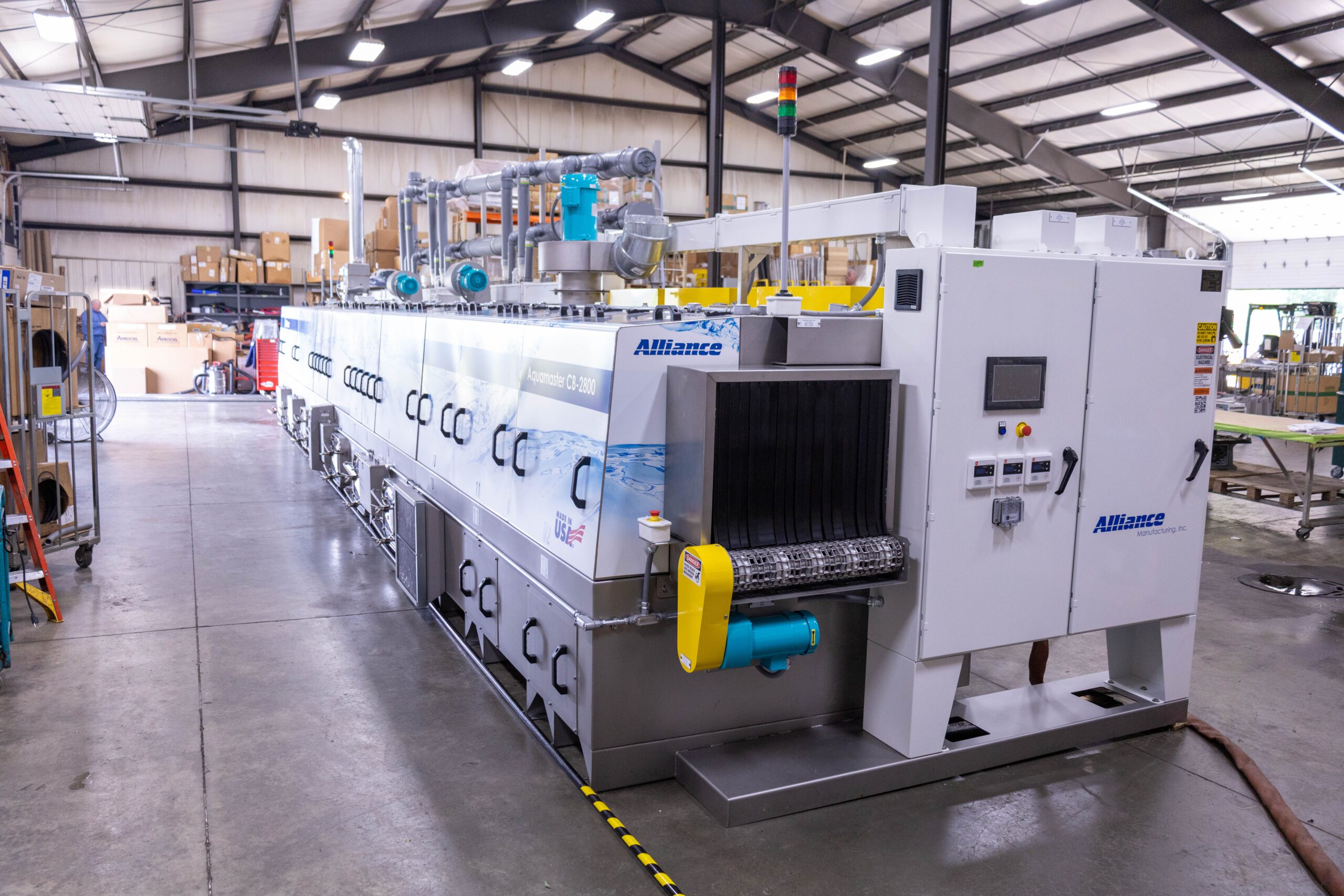
Industrial Parts Washers for Remanufacturing and Repair
Remanufacturing and repair operations depend on effective parts cleaning to prepare used components for inspection, measurement, repair, and reassembly. Alliance Manufacturing designs and builds remanufacturing parts washer systems and industrial cleaning equipment for components contaminated with oil, grease, carbon, coolant, road soil, metal particles, and other accumulated residues.
Unlike newly manufactured parts, used components can arrive with varying levels and types of contamination. Cleaning equipment must therefore account for part geometry, soil load, required cleanliness, production volume, and the next inspection or manufacturing step.
Alliance engineers cleaning systems around these application-specific requirements.
Parts Commonly Cleaned in Remanufacturing and Repair
Alliance parts cleaning systems can be configured for a wide range of applications, including:
- Transmission housings and components
- Engine blocks and cylinder heads
- Gears and shafts
- Pumps and valves
- Hydraulic components
- Bearings and housings
- Brake components
- Electric motor components
- Heavy equipment parts
- Automotive and industrial components
Depending on the application, systems can remove transmission fluid, lubricating oils, grease, carbon deposits, dirt, road soil, metal particles, coolant, and other contamination accumulated during operation.
Cleaning Used Components Before Inspection and Reassembly
Cleaning used components before inspection can help remove contamination that may obscure surfaces or interfere with repair and assembly operations.
Automating the cleaning process can provide more consistent processing than manual cleaning while helping remanufacturers manage labor requirements and production throughput.
Alliance systems can incorporate multiple cleaning stages, including heated aqueous washing, rinsing, rust inhibition, blowoff, and heated drying. Filtration and oil-removal equipment can also be integrated to help maintain cleaning solution performance.
Cleaning Complex Remanufactured Components
Used components can be challenging to clean because contamination may accumulate in recessed areas, passages, cavities, and other difficult-to-reach surfaces.
Alliance evaluates part geometry and contamination when developing the cleaning process. Spray manifolds, targeted nozzles, part positioning, indexing, rotation, immersion, and other cleaning methods can be incorporated according to the application.
Transmission Component Cleaning Example
Alliance developed a conveyorized transmission cleaning system to remove transmission fluid, oils, grease, and road soils from automatic transmission components. The system incorporates dual wash stages, rust inhibition, and heated blowoff while processing approximately 15–20 carriers every five minutes.
Repair Parts Cleaning for Service and Rebuild Operations
Repair operations may process individual components or small batches of parts with different contamination levels and cleaning requirements. An industrial parts washer can help remove oil, grease, carbon, dirt, coolant, and other residues before inspection, repair, coating, rebuilding, or assembly.
Cabinet systems can provide flexibility for facilities processing variable parts, while conveyorized or indexing systems can support higher-volume operations requiring repeatable cleaning cycles.
Engineered Around Your Cleaning Requirements
There is no single cleaning process suitable for every remanufacturing or repair operation. Alliance evaluates the parts, contaminants, production requirements, cleanliness criteria, drying needs, and available floor space before recommending a system.
Application testing can also help establish an appropriate cleaning process before equipment specifications are finalized.
Test Your Parts Before Selecting a Parts Washer
Application testing can help evaluate cleaning chemistry, temperature, spray configuration, cycle time, rinsing, rust inhibition, and drying requirements using customer parts and representative contamination.
Testing can help inform the recommended equipment configuration and cleaning process before the final system is specified.