Customer Background
A respected and highly-experienced provider of aluminum castings to a variety of customers including major national and international manufacturers of automotive, marine, off-road, construction, earthmoving, and agricultural equipment. The company provides cast aluminum parts as well as machining and other value-added services. They needed a solution for cleaning cast aluminum parts.
Challenge
The customer produced aluminum castings for automotive, marine, off-road, construction, earthmoving, and agricultural equipment applications.
Parts arrived at the cleaning stage in different conditions. Rough-cast components carried foundry-related contamination, while machined components carried coolant, cutting oils, chips, and particulate.
The washer therefore needed to clean different aluminum surfaces without using a process that could unnecessarily etch, stain, or damage the material.
Why Cleaning Aluminum Requires a Different Approach
Aluminum can react differently to cleaning chemistry than steel or cast iron. High-pH, uninhibited caustic cleaners may attack the aluminum surface and contribute to staining or etching.
For this application, the cleaning process needed to balance:
- Soil removal
- Aluminum compatibility
- Chemistry concentration
- Temperature
- Spray pressure
- Cycle time
- Part geometry
Final chemistry selection should be validated against the specific aluminum alloy, soil load, concentration, temperature, and exposure time.
Aluminum Cleaning Chemistry
Typical starting ranges for aqueous aluminum cleaning include:
| Cleaner Type | Typical pH | Application |
| Neutral aqueous | 6–9 | Mild soils and general coolant/oil removal |
| Mildly alkaline inhibited | 7–9 | General aluminum cleaning |
| Higher-pH inhibited | 10–12 | Heavier oil and soil loads |
| High-caustic, uninhibited | 12+ | Generally avoided on bare aluminum |
Higher-pH chemistry may require an inhibitor package to reduce the risk of surface attack. The appropriate chemistry should always be tested against the actual alloy and cleaning conditions.
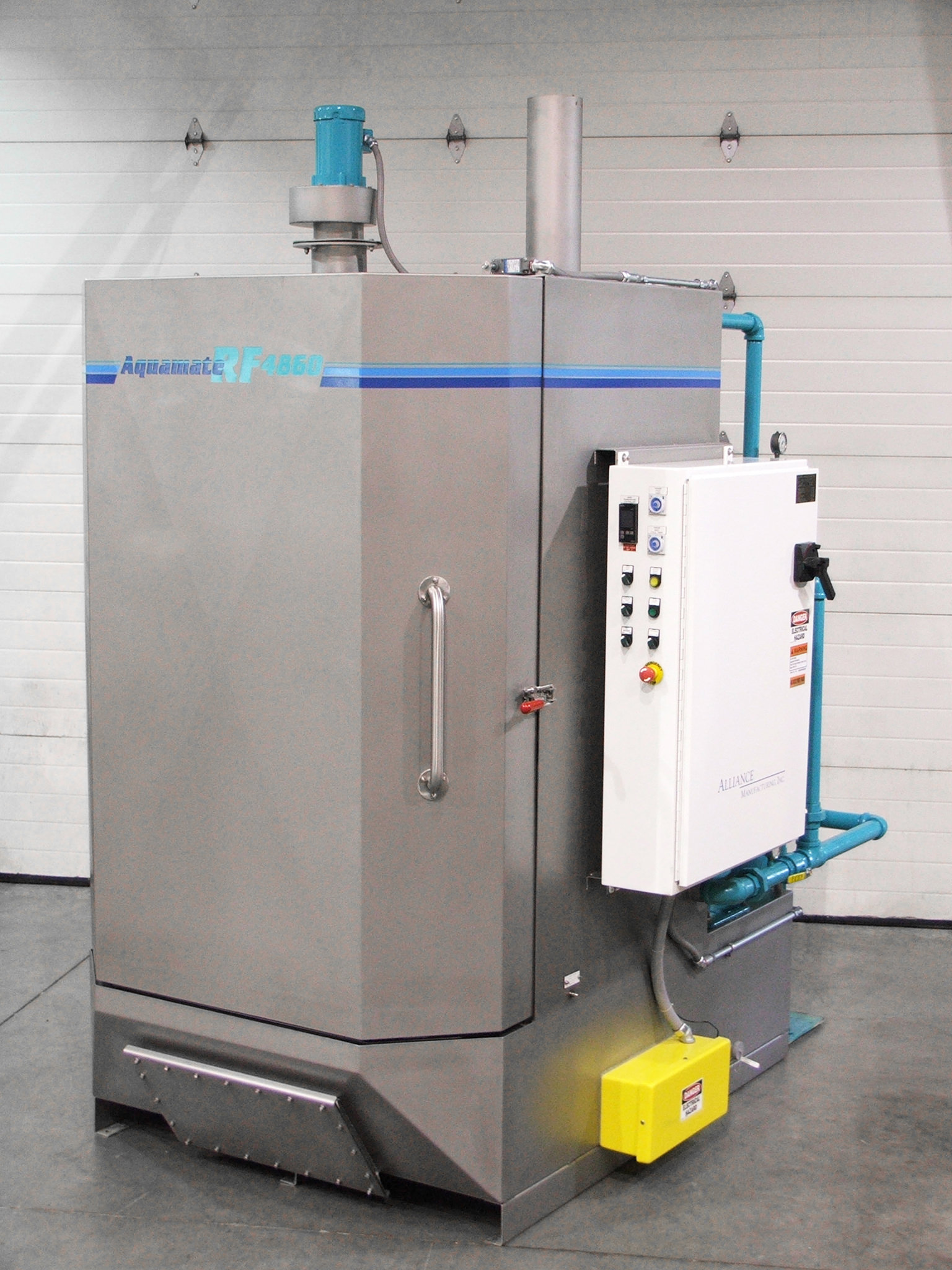
For this project, Alliance configured the RF-4860 for an aluminum-compatible wash chemistry selected around the customer’s soil load.
Spray vs. Immersion Cleaning
Spray Cleaning
High-impingement spray cleaning is effective for removing loose chips, particulate, coolant, and surface-level oil. It was selected for this project because the customer’s parts could be effectively cleaned using spray coverage.
Immersion Cleaning
Immersion or combined spray/immersion cleaning can be advantageous for parts with:
- Blind holes
- Internal passages
- Recessed cavities
- Baked-on contamination
The soak period allows cleaning chemistry to reach areas that may be difficult for spray alone to access.
Alliance cabinet and rotary washer platforms can be configured with spray, immersion, or combined cleaning processes depending on part geometry and contamination.
Solution
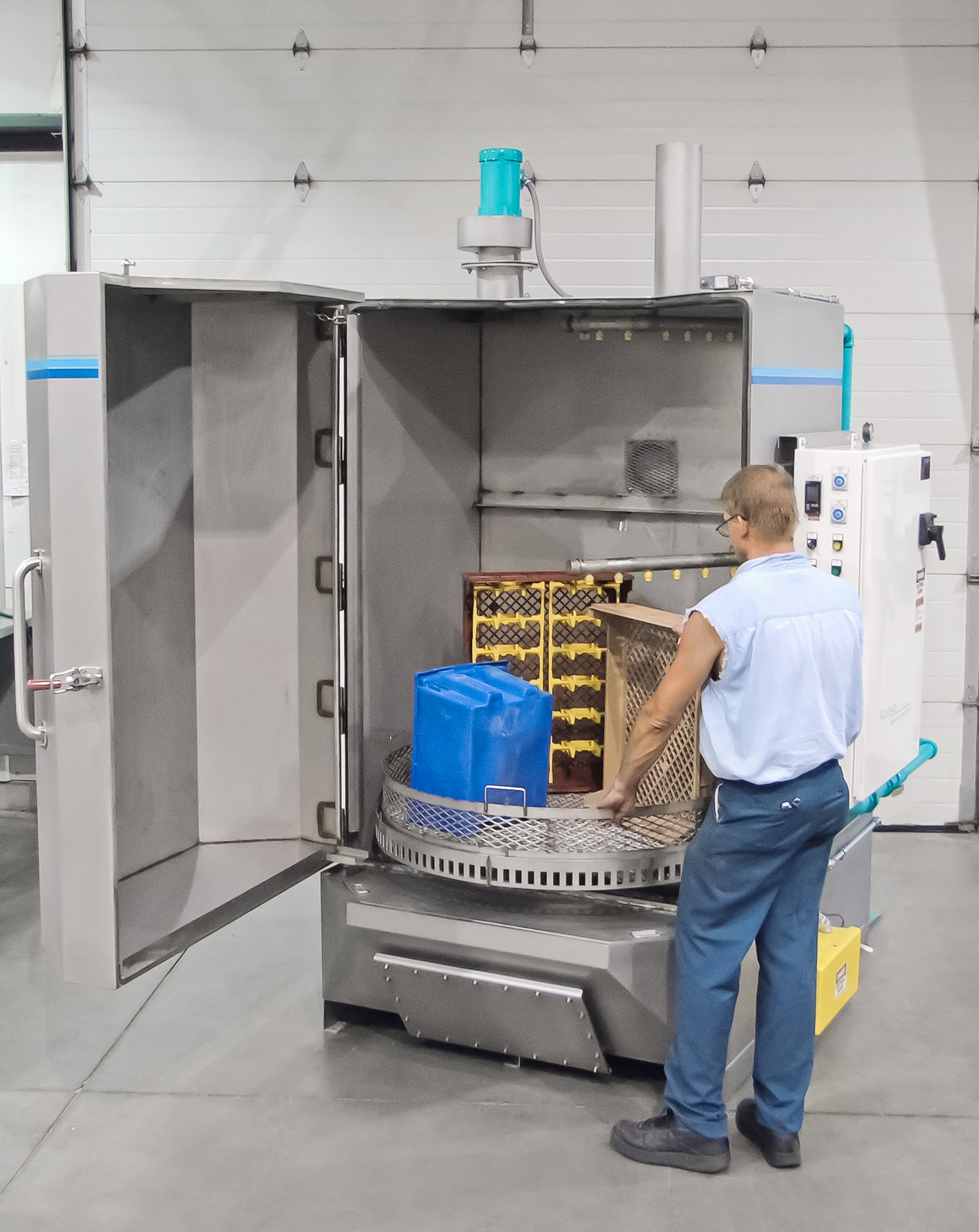
Alliance supplied an Aquamate RF-4860 front-loading cabinet-style aluminum parts washer with:
- Heavy-gauge stainless steel construction
- Heavy-duty pump and drive components
- Spray piping for parts up to 60 inches high
- Movable intermediate spray piping
- Configuration for mixed rough-cast and machined aluminum parts
- Aluminum-compatible wash chemistry
The movable spray piping allowed cleaning coverage to be adjusted for different part sizes within the same batch washer.
Degreasing Aluminum Engine Blocks
The same cleaning principles apply to aluminum engine blocks and other complex castings.
Engine blocks can contain:
- Deep coolant passages
- Blind bolt holes
- Recessed cavities
- Heavier oil and grease
These applications may benefit from immersion or combined spray/immersion cleaning, along with appropriate part orientation and nozzle placement.
Drying Aluminum Parts
Residual moisture was acceptable for this project. When parts must proceed directly to assembly, coating, plating, or another downstream process, drying may require additional consideration.
Forced heated-air blow-off can help remove surface moisture, while complex castings may require specific nozzle placement and part orientation to address trapped water.
Results and Application Benefits
The RF-4860 provided the customer with a batch cleaning platform capable of handling both rough-cast and finished-machined aluminum components.
The application demonstrates how an aluminum parts washer can be configured around:
- Aluminum-compatible chemistry
- Mixed part conditions
- Part size
- Spray coverage
- Soil type
- Required cleanliness
- Downstream process requirements
Industries Using Aluminum Parts Washers
Alliance aluminum parts washing systems can be used in:
- Automotive manufacturing
- Marine manufacturing
- Off-road equipment manufacturing
- Construction equipment manufacturing
- Earthmoving equipment manufacturing
- Agricultural equipment manufacturing
- Aluminum foundries
- Contract machining